

Jaw pain has a sneaky way of taking over your day.
At first, it is just a little tightness when you wake up. Then it becomes a dull ache while you chew. Then one day you notice the clicking, the tension, the headaches, and that tired feeling in your jaw that just will not quit.
That is when many people start searching botox for jaw pain Markham.
And honestly, it is a fair question.
If your jaw hurts, your face feels tense, and your TMJ symptoms keep coming back, you want real relief. Not fluff. Not trends. Not guesswork. You want to know whether Botox is actually useful, whether it is safe, and whether it makes sense for your situation.
The answer is this: Botox can help some people with jaw pain and TMJ-related muscle tension, but it is not the right solution for everyone.
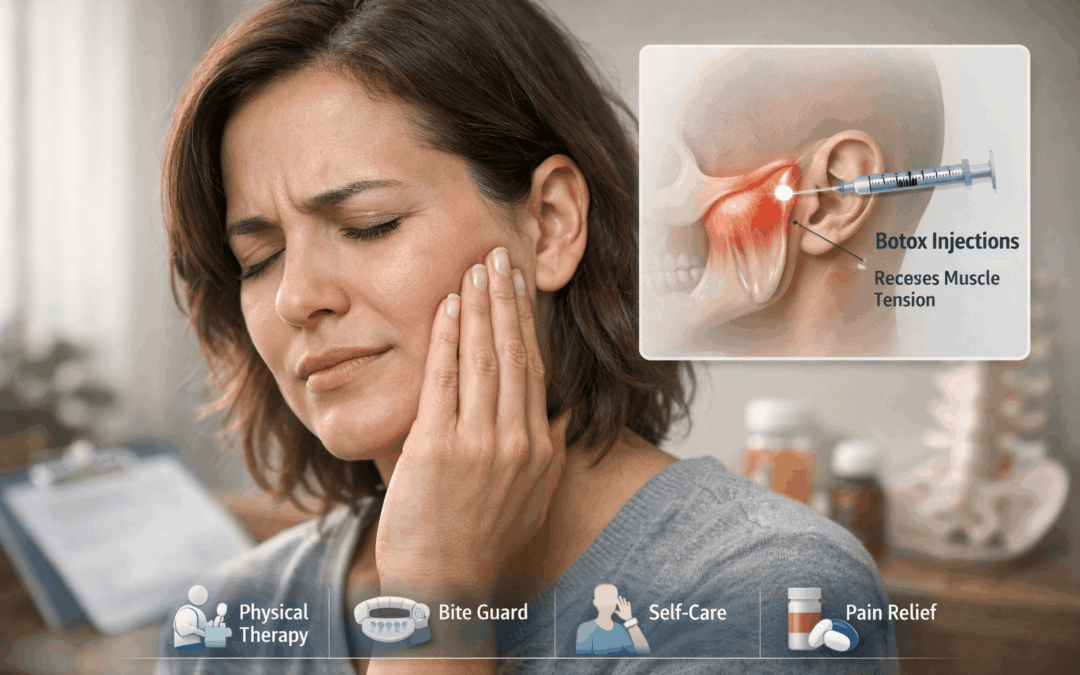
In many cases, TMJ problems improve with more conservative care first, such as self-care, physical therapy, bite appliances, and short-term pain relief strategies.
Authoritative sources like Mayo Clinic note that botulinum toxin may ease TMJ-related pain in some cases, but describe it as a treatment used more selectively rather than as the starting point for everyone.
So let’s break it down in plain English.
If you are wondering about botox for tmj treatment Markham, this guide will help you understand what it is, how it works, who it may help, and when it is time to speak with a dentist about jaw pain treatment Markham options.
What is TMJ, exactly?
TMJ stands for the temporomandibular joint. You actually have one on each side of your jaw. These joints help you talk, chew, yawn, and open and close your mouth.
When something goes wrong with the joint, the muscles around it, or the way your jaw is functioning, the problem is often grouped under TMD, which means temporomandibular disorder.
Common symptoms can include:
-
jaw pain or tenderness
-
facial aching
-
tension around the cheeks or temples
-
clicking or popping
-
headaches
-
pain when chewing
-
jaw stiffness
-
limited jaw movement or locking
These are all well-recognized symptoms of TMD. The National Institute of Dental and Craniofacial Research lists pain in the chewing muscles or jaw joint, pain spreading to the face or neck, stiffness, limited movement, and painful clicking or popping among common signs.
That matters because not all jaw pain comes from the exact same source.
Some people mainly have muscle tension and clenching. Others have a more joint-based issue. Some have a mix of both. That is a big reason why tmj botox Markham is not a one-size-fits-all answer.
How does Botox help jaw pain?
Botox works by temporarily reducing the activity of certain muscles.
In the context of TMJ-related pain, it is often used in overactive jaw muscles, especially when a person clenches or grinds their teeth, or when the muscles around the jaw stay tight and irritated for long periods.
The basic idea is simple: if those muscles are overworking, relaxing them may reduce strain, tension, and pain.
Mayo Clinic explains that Botox injections temporarily prevent a muscle from moving for a limited time, and notes that botulinum toxin may sometimes ease pain related to TMJ disorders.
So yes, botox for jaw pain Markham may help in the right case.
But here is the important part: it tends to make the most sense when the pain is muscular, not when the main problem is deeper inside the joint itself.
Research reviews also reflect that nuance. A 2024 umbrella review and a 2022 review found that evidence is more supportive or at least more promising for myogenous TMD meaning muscle-related TMD, while evidence is still limited or unclear for more articular or joint-centered TMJ disorders.
Does Botox really help TMJ?
Sometimes yes. Sometimes not enough. Sometimes it helps one part of the problem but not the whole picture.
That is the honest answer.
For the right patient, Botox may help reduce:
-
jaw muscle tension
-
clenching-related pain
-
tension headaches linked to jaw strain
-
soreness in the masseter area
-
pressure from nighttime grinding
But it is not magic.
It does not permanently “fix” the reason you developed TMJ symptoms in the first place. If stress, grinding, posture, sleep issues, bite strain, or inflammation are part of the problem, those may still need attention too.
That is why a good dentist will not just ask, “Do you want Botox?”
They should also ask, “Why is your jaw hurting?”
That distinction matters a lot.
When Botox may be worth considering
You may want to ask about botox tmj treatment Markham if:
-
your jaw muscles feel constantly tight or overworked
-
you clench or grind your teeth
-
your cheeks feel sore, heavy, or tired
-
you have already tried simpler treatments and still feel stuck
-
your pain seems to be driven more by muscle tension than by a clear joint injury
Many TMJ cases improve with noninvasive treatment first. Family medicine guidance and NIDCR-related summaries both emphasize that conservative care, self-care, and noninvasive options are often the initial approach because many cases improve without aggressive treatment.
So Botox is often better thought of as one tool in the toolbox, not always the first move.
When Botox may not be the best first step
Botox may not be the ideal starting point if:
-
your jaw pain is mostly joint-related
-
your jaw locks frequently
-
you have major bite changes
-
trauma may be involved
-
the pain may be linked to infection, dental issues, or another condition that needs diagnosis first
A dentist needs to rule out other causes of jaw pain treatment Markham needs, because not every sore jaw is a Botox case.
For example, teeth grinding, arthritis, injury, posture habits, stress, and other factors can all contribute to TMD symptoms. Cleveland Clinic and other medical references also note that clenching, bruxism, injury, arthritis, and stress can play a role.
How long does TMJ Botox last?
This is one of the biggest questions people ask.
In general, Botox is not permanent. Mayo Clinic describes Botox as a treatment that affects muscle movement for a limited time. In real-world dental and medical practice, symptom relief is often discussed in terms of a few months, though exact duration varies from person to person.
How long relief lasts can depend on:
-
how strong your jaw muscles are
-
how much you clench or grind
-
your body’s metabolism
-
the dose used
-
whether the true cause of pain is mainly muscular
Some people feel improvement relatively quickly. Others need time. Some feel a meaningful reduction in tension but still need other forms of care alongside it.
Is Botox for TMJ safe?
When performed by a properly trained healthcare professional, Botox is generally considered safe for appropriate candidates. But “safe” does not mean “casual.”
This is your face. Your bite. Your muscle function.
So evaluation matters.
Possible side effects may include soreness at injection sites, temporary weakness in nearby muscles, changes in chewing comfort, or asymmetry if dosing or placement is not right. That is why this should be handled by someone who understands both facial anatomy and dental function, not just cosmetics.
The bigger point is this: TMJ care should be diagnosis-first, treatment-second.
People Also Ask
Can Botox stop jaw clenching?
It can reduce the force of muscle contraction in some patients, which may help with clenching-related tension and soreness. But it does not automatically remove the habit, stress trigger, or sleep-related cause behind clenching. That is why many people still benefit from a broader plan, such as a night guard, self-care, or stress management alongside treatment. Conservative therapies remain a common first step in TMD care.
Is Botox for TMJ painful?
Most people describe it as manageable and quick. You may feel a small pinch, but the procedure itself is usually brief. The bigger question is not whether the injections sting for a moment. The real question is whether the treatment matches the cause of your pain.
How do I know if my jaw pain is muscle-related?
Muscle-related jaw pain often feels like tightness, pressure, soreness, or fatigue in the cheeks or temples, especially if you clench or grind. TMD symptoms can include pain in chewing muscles, facial pain, jaw stiffness, and headaches. A dentist can help determine whether your symptoms are mostly muscular, joint-based, or mixed.
Is Botox the best treatment for TMJ?
Not always. Many patients improve with noninvasive care first. Evidence for Botox is mixed overall and appears more promising for muscle-related TMD than for joint-centered TMJ disorders. That means the “best” treatment depends on what is actually causing your symptoms.
What other treatments can help TMJ?
Depending on the cause, treatment may include:
-
self-care
-
softer foods during flare-ups
-
short-term anti-inflammatory medication when appropriate
-
physical therapy
-
bite appliances or occlusal devices
-
stress reduction
-
posture improvement
-
targeted dental care
AAFP guidance notes that many patients improve with a combination of noninvasive therapies, including self-care, pharmacotherapy, physical therapy, and occlusal devices.
Why local care matters in Markham
If you are searching botox for jaw pain Markham, you are probably not just looking for information. You are looking for someone nearby who can actually assess what is going on.
That matters.
Because the right provider should not rush you into treatment just because Botox is trendy. They should look at your symptoms, your muscle patterns, your bite, your jaw movement, and your overall dental health.
That is what makes a real difference.
A thoughtful local assessment can help you understand whether you need:
-
Botox
-
a bite appliance
-
a more conservative TMJ plan
-
treatment for another dental issue causing referred pain
-
a combination approach
In other words, good jaw pain treatment Markham starts with clarity.
So, does Botox for jaw pain in Markham really help TMJ?
Yes, it can help.
But it helps the most when it is used for the right kind of TMJ problem.
If your symptoms are driven by clenching, grinding, and overactive jaw muscles, Botox may offer meaningful relief. If your symptoms are mainly joint-based, or if the real issue has not been diagnosed yet, Botox may be incomplete or not the best first option.
That is why a proper consultation matters so much.
You do not need to guess your way through jaw pain. And you definitely do not need to self-diagnose based on one social media post or one quick search result.
If your jaw feels tight, sore, tired, or painful, book a consultation with a dentist in Markham who can evaluate your symptoms properly and guide you toward the treatment that actually fits your case. The right plan could include tmj botox Markham, but it should always begin with a real assessment.
Key Takeaways
-
Botox for jaw pain Markham can help some patients, especially when jaw pain is linked to muscle tension, clenching, or grinding.
-
It is not a universal fix for every TMJ problem.
-
Evidence is stronger for muscle-related TMD than for joint-centered TMJ disorders.
-
Many people improve first with conservative care such as self-care, physical therapy, and bite appliances.
-
The smartest next step is a proper dental evaluation to find out what is really causing your jaw pain.
Book a consultation with your dentist to get clear answers, a proper diagnosis, and a treatment plan that helps you move your jaw comfortably again.